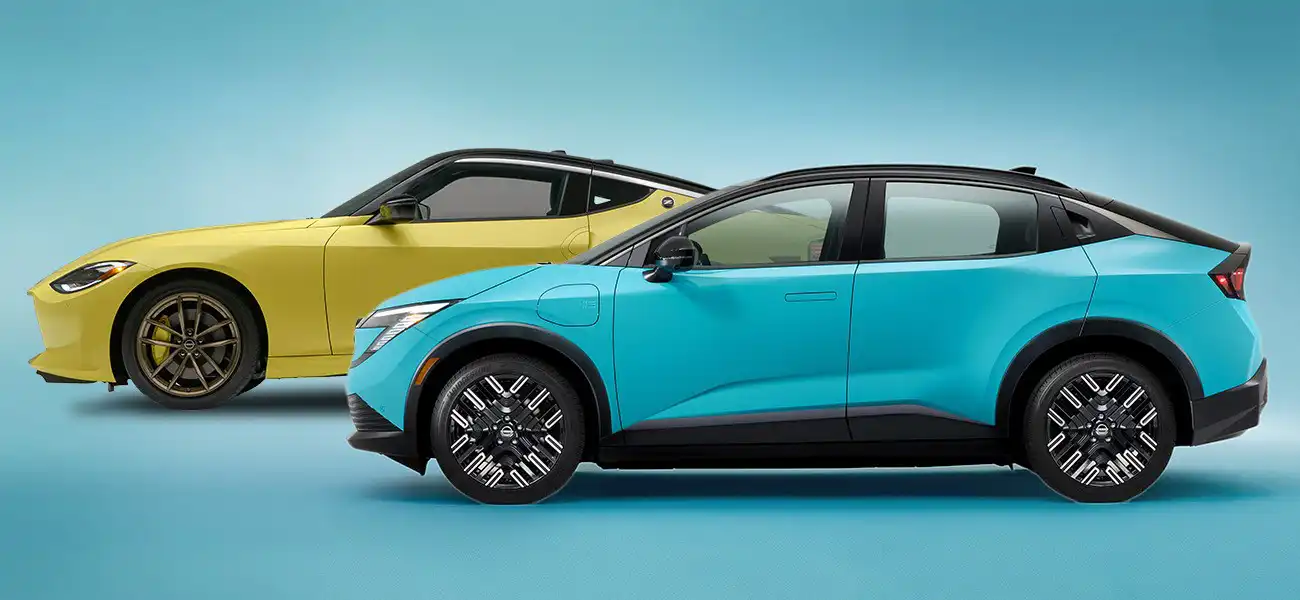
What makes a Nissan feel like a Nissan? Traits such as confident handling, everyday comfort and user-friendly technology are shared across the lineup. To maintain that sense of Nissan-ness, engineers move between vehicles in vastly different segments.
For example, many of the engineers who tuned the all-new 2026 LEAF1 (expected availability fall 2025) for North America also helped develop the legendary Z sports car.
“Our goal is brand consistency across every segment,” said Mathew Wright, a research and development engineer based at Nissan’s Arizona Testing Center. “No matter the vehicle, we want to deliver a comfortable, secure experience so customers are confident behind the wheel.”
Bringing Nissan-ness to life
To create a car worthy of the Nissan badge, teams focus on several key qualities. Driving dynamics are among the most important.
“Precise steering and responsive acceleration aren’t just for sports cars,” Wright said.
The same engineers who honed Z’s performance applied those lessons to LEAF, adapting them to an EV platform while preserving Nissan’s signature feel.
“We made countless adjustments to help ensure LEAF drivers enjoy a fun, confident ride,” added Wright. “The steering precision and controllability are aligned with those in other Nissan vehicles, giving a consistent impression across the lineup.”
Achieving this requires teams with an enormous amount of expertise, and having people who have worked on other vehicles in Nissan’s portfolio provides a diverse knowledge base.
The LEAF engineering team includes people who have helped develop trucks, SUVs, sports cars and sedans.
“We want variety in our product experience,” said Christian Spencer, Nissan senior manager of Marketability, who has recently worked on Z, Rogue and LEAF. “It allows us to apply the best insights from each vehicle to new models.”
Spencer said the team uses the same road surfaces and proving grounds, and most of the same dynamic performance experts, in the development process for all vehicles.
“We also use shared tuning parameters across the brand,” he said. “Having uniform methods helps us ensure consistent Nissan quality in every car.”
Target class-above comfort
Exceptional comfort is another hallmark of Nissan vehicles. The all-new LEAF uses a redesigned motor and motor mounts that cut vibration by 25% compared to the outgoing model. Its floor is 80% stiffer, and the doors now feature elements that significantly enhance noise isolation.

LEAF’s rear suspension is largely shared with the larger Nissan ARIYA, thanks in part to their common EV platform.
The 2026 model also has a new multilink rear suspension that the team adapted from the system in the Nissan ARIYA, which reduced impact stiffness by nearly 30%. That means LEAF more easily absorbs bumps and potholes.
“Our ride comfort is targeted to be a class above,” Wright said. “Road imperfections are quickly dissipated with minimal noise and vibration, which provides a high-quality feel that elevates it above the segment.”
The shock-absorber tuning for the North American market was done in Arizona.
Making an EV that’s easy to live with
To reach the assembly line, every Nissan must deliver excellent ergonomics and advanced yet intuitive technology. In the all-new LEAF, that means accessible physical controls to complement in-screen selections.
"We want everything laid out logically,” Spencer said. “Frequently used controls should be close-at-hand for comfort and ease of use. Across all models, we want things like windows, climate and audio controls to be simple and easily accessible.”
When it came to charging, LEAF engineers faced a highly competitive market and knew they had to make LEAF stand out while remaining affordable. Integrating two charge ports – NACS and J1772 – was a crucial step in development.
“The team had to be at the leading edge of the industry to figure out how to integrate NACS. We leaned on our team’s expertise and customer feedback from LEAF’s 15 years in the market,” Wright said. “The team delivered a seamless NACS execution, opening LEAF to drastically more chargers and enhancing the public charging experience. The time we poured into LEAF is clear when looking at other options in the segment.”
They accomplished this while debuting LEAF at a starting MSRP of CA$44,998, while offering a free home charger to the first 200 customers2.

LEAF’s passenger-side fender features a NACS fast charge port, unlocking the faster charging speeds of more than 15,000 Tesla Superchargers
In tuning both Z and LEAF, engineers drove thousands of kms in a wide variety of environments across North America. From the scorching Arizona summer to bone-chilling Canadian winters, they tested the vehicles for reliable performance in different climates, road conditions and even altitudes.
“What they share is delivering what their drivers want at an incredible value,” Wright said. “A car is a significant investment. We want to match the right features and performance to the audience.”
From Z to LEAF, the vehicles may serve different drivers, but they share one consistent mission: to deliver Nissan-ness — confidence, comfort and intuitive technology — across every segment.
About Nissan Marketability
Christian Spencer is a senior manager of Marketability at Nissan Technical Center North America in Farmington Hills, Michigan. He has worked for Nissan for 22 years. Spencer has a bachelor of science in mechanical engineering and a master's in business administration from the University of Michigan.
Mathew Wright is a research and development engineer at Nissan’s Arizona Testing Center in Stanfield, Arizona. He has worked at Nissan for 21 years. Wright has a bachelor of science in mechanical engineering from Kettering University.
- 30 -
- 2026 Nissan LEAF not yet available for purchase. Expected availability fall 2025. Pre-production model shown. Actual production model may vary.
- This limited-time offer is available to the first 200 qualifying customers and is subject to terms and conditions.